Subterranean termite soil and structural defense protects properties where western subterranean termites ( Reticulitermes hesperus ) travel from subterranean moisture zones into structural lumber. Glacial till and…
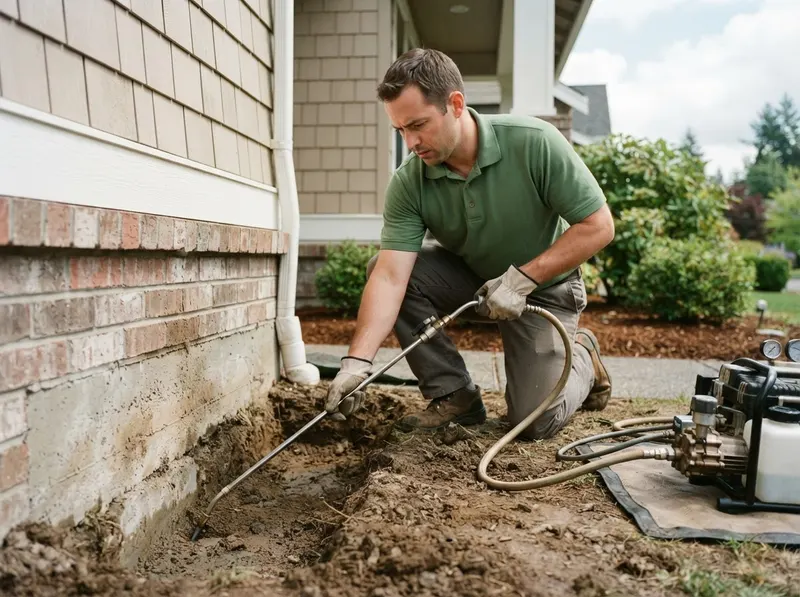
Subterranean termite soil and structural defense protects properties where western subterranean termites (Reticulitermes hesperus) travel from subterranean moisture zones into structural lumber. Glacial till and elevated annual rainfall across the Puget Sound basin maintain prolonged subterranean dampness, driving subterranean colonies upward through foundation cold joints, hairline stem wall fractures, and porous hollow-block masonry. In neighborhoods near dense tree canopies such as Bridle Trails, Finn Hill, and Market, native soil maintains the wood-to-ground moisture contact necessary for termite colonies to establish exploratory mud tubes. Technicians locate subterranean pathways adhering to EPA Integrated Pest Management principles, treating root access points rather than broadcasting indiscriminate interior sprays.
Technicians deploy liquid barrier chemistry along the building envelope following guidelines verified by the Washington State Department of Agriculture. The primary methodology involves continuous trenching around concrete perimeters, excavating trenches 6 inches wide by 6 inches deep to apply non-repellent termiticides directly to the subgrade backfill. Where horizontal concrete slabs, front porches, or garage aprons sit flush against structural framing in areas like Totem Lake and Juanita, masonry bits drill 0.5-inch ports spaced 12 inches apart to inject termiticide directly beneath the slab into sub-base gravel. Interior crawlspace wood framing showing early wood grain consumption receives localized borate surface applications adhering to structural standards recognized by the American Wood Protection Association and testing protocols from the ASTM International wood preservation committee.
Selecting structural perimeter defense over topical interior spot sprays addresses colony biology directly. Subterranean termites dwell deep within damp earth, rendering aerosol wall sprays ineffective because topical sprays do not impact subterranean nesting chambers or foraging networks. Liquid barrier trenching creates a continuous chemically treated zone that worker termites pass through unnoticed, carrying active ingredients back to the central subterranean colony through social grooming behaviors detailed by the Entomological Society of America. Properties bordering open natural acreage near Saint Edward State Park or wetland corridors around Juanita Bay Park face continuous pest pressure from decaying natural forest debris. For these high-risk perimeters, Oakridge Pest Response establishes treated soil barriers that prevent structural settlement and safeguard equity without introducing harsh residual odors into indoor living areas.
Every job gets a firm, written price after a free on-site visit.
For standards, safe disposal, and service guidance on PEST CONTROL SEVICE in Kirkland, WA, useful references include U.S. EPA, ENERGY STAR, U.S. Dept. of Energy, Consumer.gov, U.S. Census Bureau, and Google Maps. General consumer and small-business resources are available from USA.gov, Better Business Bureau, FTC Consumer Advice, U.S. Small Business Administration, and Ready.gov.
Tell us about your subterranean termite soil and structural defense job in Kirkland and we'll send a clear, written quote, usually the same day.
 Oakridge Pest Response