Residential architecture across King County presents distinct structural vulnerabilities due to maritime climate moisture and dense vegetation cover. In older homes throughout the Market and Moss Bay neighborhoods,…
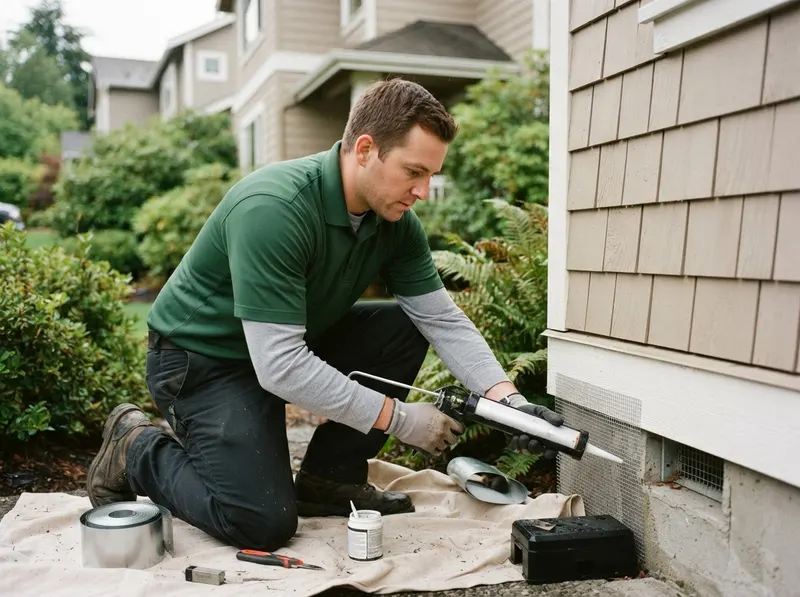
Residential architecture across King County presents distinct structural vulnerabilities due to maritime climate moisture and dense vegetation cover. In older homes throughout the Market and Moss Bay neighborhoods, aged stone foundations and settling mudsills frequently create gaps exceeding 0.25 inches, the minimum aperture required for mouse entry according to structural research published by the Norwegian Polar Institute regarding rodent burrowing mechanics. Conversely, newer multi-story construction near The Village at Totem Lake and Finn Hill often features complex roof junction flashings and dormer returns where climbing roof rats exploit overhanging Douglas fir branches to penetrate unmeshed attic louvers. A proper exclusion strategy transitions away from indefinite poison broadcast by using physical materials: 1/4-inch 23-gauge galvanized hardware cloth, copper mesh infill, and metal-reinforced hydraulic mortar. Guidance from the Washington State University Extension highlights that exterior non-chemical barriers represent the single durable mechanism to stop seasonal reinvasion when autumn temperatures drop below 45 degrees Fahrenheit.
Effective rodent remediation requires separating initial abatement from definitive exclusion. Immediate mechanical snap trapping inside living spaces, attics, and crawlspaces quickly eliminates resident populations without risking hidden carcass decomposition behind drywall. Chemical rodenticides inside residential walls frequently result in severe secondary odor issues and potential nontarget toxicity risks documented by the US Environmental Protection Agency. The National Pest Management Association emphasizes that setting un-baited mechanical snap traps along confirmed pheromone runways achieves swift knockdown within 48 to 72 hours. For properties bordering Saint Edward State Park, Bridle Trails, or the Cross Kirkland Corridor, outdoor rodent pressure remains continuous year-round due to greenbelt wildlife corridors; this environmental dynamic makes foundation sealing, crawlspace vent replacement, and garage door bottom seal upgrades non-negotiable for lasting protection.
Crawlspace integrity represents the primary failure point across homes in Juanita, Rose Hill, and Kingsgate. High soil moisture in Lake Washington basin lowlands degrades subfloor insulation, creating an inviting microclimate for Norway rat burrowing. Comprehensive protocols require inspecting continuous stem-wall foundations, vapor barrier integrity conforming to US Department of Energy crawlspace containment standards, and checking plumbing stack penetrations through subflooring. The Centers for Disease Control and Prevention establishes strict safety measures for removing rodent-fouled insulation, mandating HEPA-filtered vacuum systems and negative-pressure extraction to neutralize airborne pathogens like Hantavirus and lymphocytic choriomeningitis. Structural timber damage from gnawing is repaired using heavy-gauge sheet steel backing before re-insulation.
Selecting the appropriate service scope depends on whether infestation is localized or system-wide. A simple crawlspace access hatch replacement or single vent screening suits a newly discovered, isolated mouse sighting, whereas heavy rat activity causing attic insulation cross-contamination requires full architectural exclusion coupled with multiple trap checks. According to construction guidelines enforced under the City of Kirkland Building Division and building codes detailed by the International Code Council, all exterior pest screens on crawlspace crawl-holes must maintain opening sizes between 1/4 inch and 1/8 inch to sustain proper sub-floor ventilation ratios while keeping pests out. Standards supported by the National Wildlife Federation and the National Audubon Society also urge strict structural exclusion over broadcast bait stations to protect predatory raptors and local wildlife across regional greenbelts. Oakridge Pest Response executes precise perimeter assessments, providing exact written scope parameters before any mechanical hardware is fastened.
Every job gets a firm, written price after a free on-site visit.
For standards, safe disposal, and service guidance on PEST CONTROL SEVICE in Kirkland, WA, useful references include U.S. EPA, ENERGY STAR, U.S. Dept. of Energy, Consumer.gov, U.S. Census Bureau, and Google Maps. General consumer and small-business resources are available from USA.gov, Better Business Bureau, FTC Consumer Advice, U.S. Small Business Administration, and Ready.gov.
Tell us about your rodent exclusion and abatement job in Kirkland and we'll send a clear, written quote, usually the same day.
 Oakridge Pest Response