Residential properties throughout King County encounter severe biological pressure from structural timber pests due to the temperate marine microclimate of the Puget Sound basin. Structural wood-destroying organisms…
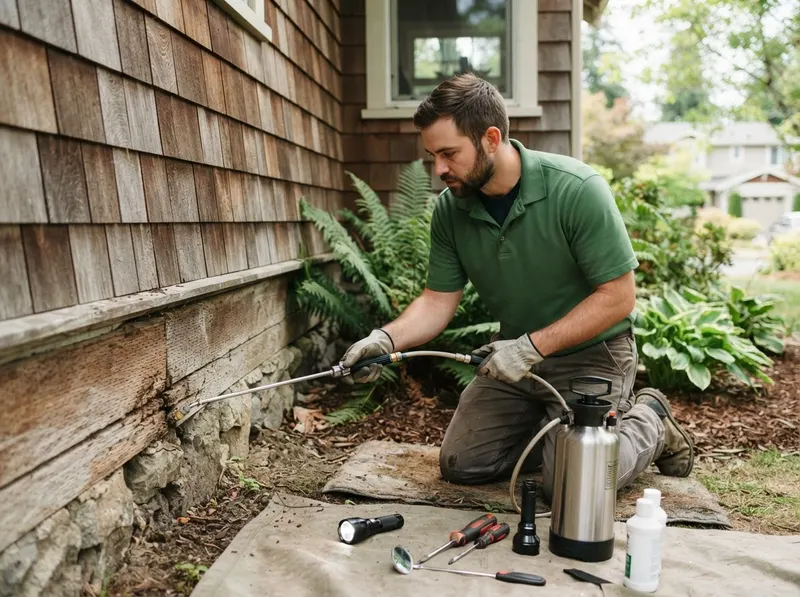
Residential properties throughout King County encounter severe biological pressure from structural timber pests due to the temperate marine microclimate of the Puget Sound basin. Structural wood-destroying organisms such as the western carpenter ant do not digest wood like subterranean termites; instead, worker ants excavate smooth nesting galleries directly across softened fir framing, sill plates, and subfloor assemblies. In neighborhoods like Juanita, Finn Hill, and Market, dense mature canopies of Douglas fir and western red cedar create persistent exterior moisture along roof valleys and crawlspace foundation lines. According to the Washington State University Department of Entomology, parent colonies frequently establish primary nests in decayed outdoor stumps or greenbelts before satellite colonies migrate indoors to colonize damp wall studs behind compromised flashing or shower pans. When unchecked, a single satellite colony containing 2,000 to 10,000 workers hollows out vertical wall studs, compromising structural deflection ratings and reducing the physical equity of single-family residences.
Effective structural mitigation departs from traditional repellent liquid barriers, which merely scatter parent colonies into isolated auxiliary wall bays. The control methodology governed by the Washington State Department of Agriculture Pesticide Management Division mandates the judicious application of non-repellent transfer agents and localized systemic dusts. When treating properties in Houghton, Rose Hill, and Bridle Trails, technicians deploy localized mechanical scoping tools to map gallery distribution along roof lines, ledger boards, and crawlspace perimeters. Active void injections utilize microfine desiccant formulations containing silica dust, registered through the United States Environmental Protection Agency, directly into parent excavations. Foraging workers unknowingly cross treated foundation contact zones and translocate active chemistries deep into primary queens through natural social grooming behaviors known as trophallaxis, achieving colony elimination without aerosolizing volatile organic compounds into primary kitchen spaces or bedrooms.
Subterranean crawlspaces represent the primary vector of vulnerability in older homes situated near Moss Bay and Kingsgate. Dampness accumulating from high seasonal water tables creates wood moisture levels above the 20 percent threshold, accelerating decay caused by moisture ants and anobiid powderpost beetles as outlined by the USDA Forest Service Forest Health Protection guidelines. Structural protection protocols require a systematic five-step execution sequence: First, technicians complete a structural moisture assessment using calibrated pinned moisture meters along framing timbers within 18 inches of soil contact. Second, technicians inspect all exterior building envelopes for vegetation contact, recommending a clear 24-inch clearance zone in accordance with Public Health Seattle and King County environmental sanitation recommendations. Third, technicians inject targeted structural voids with low-toxicity formulations compliant with the standards set by the Pest Control Technology technical portal. Fourth, technicians apply foundation-level perimeter micro-barriers to stem re-infestation corridors along concrete footings. Fifth, homeowners receive a definitive physical exclusion plan highlighting damaged fascia, downspout misdirections, and crawlspace venting adjustments aligned with residential codes documented by the City of Kirkland Planning and Building Department.
Property owners evaluating pest control options face a distinct trade-off between broad-spectrum exterior monthly chemical applications and specialized structural insect exclusion programs. Continuous spray subscriptions broadcast indiscriminate neurotoxins around exterior landscaping, which often damages beneficial non-target organisms cataloged by the Xerces Society for Invertebrate Conservation without addressing internal nesting galleries hidden behind dry interior walls. Conversely, focused structural exclusion and targeted nest extraction demand a higher initial diagnostic effort and thorough site inspections around window headers, attic joists, and plumbing penetrations. This focused approach addresses the moisture source driving the infestation, stabilizes indoor air quality around residential living quarters, and eliminates the root wood-destroying colony without locking property owners into repetitive spray contracts. When localized crawlspace timber repair is required alongside insect remediation, standards provided by the American Wood Council ensure that replacement structural members maintain appropriate load resistance across wet-service construction environments.
Every job gets a firm, written price after a free on-site visit.
For standards, safe disposal, and service guidance on PEST CONTROL SEVICE in Kirkland, WA, useful references include U.S. EPA, ENERGY STAR, U.S. Dept. of Energy, Consumer.gov, U.S. Census Bureau, and Google Maps. General consumer and small-business resources are available from USA.gov, Better Business Bureau, FTC Consumer Advice, U.S. Small Business Administration, and Ready.gov.
Tell us about your carpenter ant and wood-boring insect treatment job in Kirkland and we'll send a clear, written quote, usually the same day.
 Oakridge Pest Response