Bed bug infestations in King County multi-family units and single-family residences require a decisive remediation framework rather than superficial chemical sprays. In neighborhoods such as Totem Lake, Juanita, and…
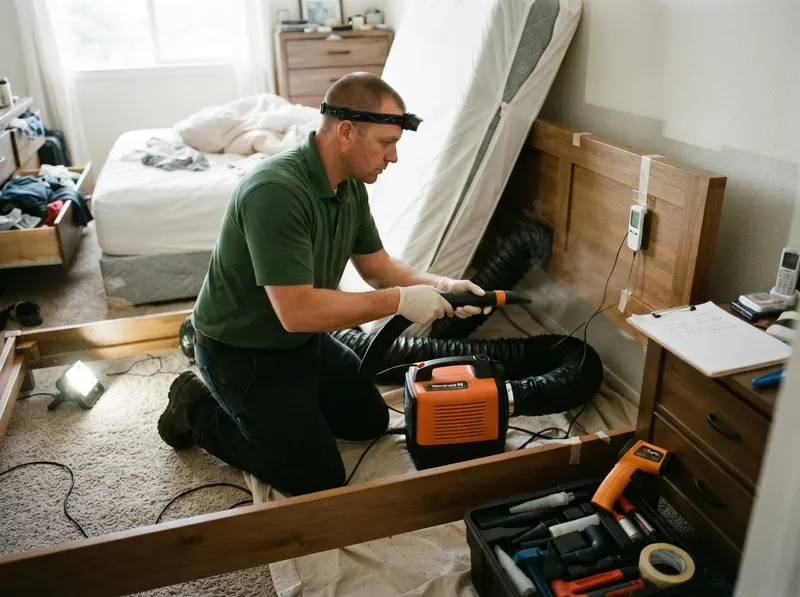
Bed bug infestations in King County multi-family units and single-family residences require a decisive remediation framework rather than superficial chemical sprays. In neighborhoods such as Totem Lake, Juanita, and Rose Hill, bed bug thermal and precision remediation in Kirkland deploys directed high-temperature convective airflow using commercial-grade heating units. The process relies on bringing structural ambient air between 125°F and 135°F, adhering strictly to thermal kill metrics documented by the US Environmental Protection Agency. By holding lethal core temperatures for a minimum duration of 90 minutes across all targeted zones, heat permeates wall cavities, deep mattress cores, and behind subfloor trim without introducing volatile synthetic insecticides into sleeping spaces.
Precision remediation operates as the necessary mechanical partner to structural heating. Following convective heat distribution, technicians deploy specialized filtration vacuums meeting standards established by the Centers for Disease Control and Prevention to physically remove dead specimens, discarded exuviae, and viable eggs from structural gaps. Along perimeter baseboards, non-toxic amorphous silica dust tested through the Pest Control Technology technical library provides long-term desiccation barriers that compromise insect cuticles. This mechanical approach aligns with urban pest guidelines cataloged by the Oregon State University Extension Service and prevents the chemical resistance challenges outlined by the Entomological Society of America.
Property construction across the Highlands, Market, and Bridle Trails districts dictates thermal planning. Older wood-frame structures near the Cross Kirkland Corridor feature plaster lath and settling floorboards that require high-velocity directional fans to eliminate cool micro-air pockets near external foundations. In dense mixed-use complexes around Marina Park Pavilion or The Village at Totem Lake, adjacent unit inspections follow protocols published by the Public Health Seattle and King County agency to halt vertical dispersion through common plumbing runs. Technical application standards also reference consumer safety thresholds from the US Consumer Product Safety Commission, thermal monitoring methods supported by the National Institute of Standards and Technology, and integrated pest management criteria from the Northeastern IPM Center and the University of California Statewide IPM Program.
Choosing thermal remediation over conventional pesticide spot-treatments eliminates recurring re-entry intervals and limits disruption to a single service day. The operational trade-off requires complete homeowner preparation: heat-sensitive items including pressurized canisters, wax candles, and certain electronics must be isolated or staged outside the treatment footprint. Oakridge Pest Response establishes clear arrival windows and structural checklists, allowing occupants to reoccupy their living environments the same evening once the structure returns to room temperature.
Every job gets a firm, written price after a free on-site visit.
For standards, safe disposal, and service guidance on PEST CONTROL SEVICE in Kirkland, WA, useful references include U.S. EPA, ENERGY STAR, U.S. Dept. of Energy, Consumer.gov, U.S. Census Bureau, and Google Maps. General consumer and small-business resources are available from USA.gov, Better Business Bureau, FTC Consumer Advice, U.S. Small Business Administration, and Ready.gov.
Tell us about your bed bug thermal and precision remediation job in Kirkland and we'll send a clear, written quote, usually the same day.
 Oakridge Pest Response